
How to Select the Perfect BLDC Motor for Your Drone
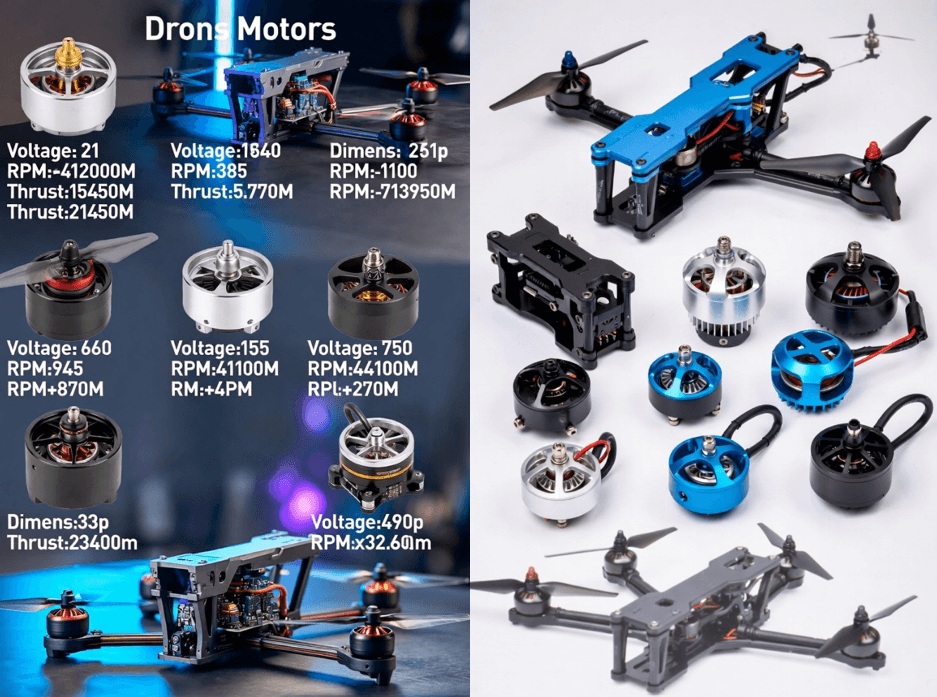
Choosing the correct BLDC (Brushless DC) motor is one of the most critical decisions when designing or building a drone. A wrong motor choice can lead to poor flight time, overheating, unstable flight, or even complete failure in the air. This guide explains how to choose a BLDC motor for a drone, step by step, in a clear and professional way—whether you are a beginner or an advanced builder.
Understand What a BLDC Motor Does in a Drone
A BLDC motor converts electrical energy from the battery into rotational force that spins the propeller. In a drone, motors generate thrust (lift) that must overcome total drone weight, and motors must respond fast and precisely for stable flight. This means power alone is not enough. Efficiency, speed control, torque, and matching with other components are equally important.
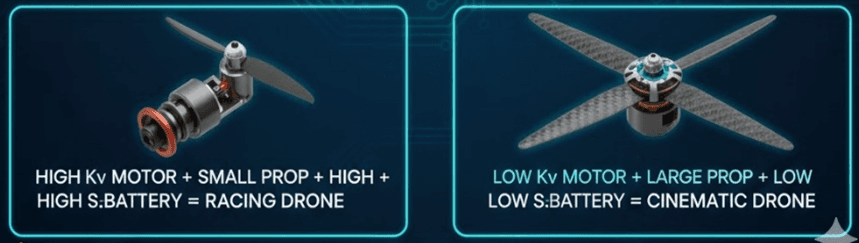
First Rule: Know Your Drone Type
Before selecting any motor, clearly define what type of drone you are building. There is no 'best motor' for all drones. There is only the 'right motor' for your mission.
Foundational Motor Specifications & Physics
KV Constant (RPM/Volt)
Definition: Rotational velocity per applied volt under no-load conditions. The KV rating determines how fast your motor spins at a given voltage.
- 1Low KV (400-800): High-torque output. Paired with large-diameter propellers (≥7"). Ideal for heavy-lift and low-RPM efficiency.
- 2Medium KV (1200-1800): Balanced torque-RPM profile. Standard for 5"-7" freestyle and cinematography platforms.
- 3High KV (2000-3000+): High-RPM, lower torque. Reserved for small propellers (≤4") on lightweight racing drones.
RPM ≈ KV × Battery Voltage (under load). Example: A 1750KV motor on a 6S battery (25.2V nominal) targets ~44,100 RPM before load and efficiency losses.
Stator Dimensions (Naming Convention)
Motor naming format is XXYY where XX = stator diameter (mm), YY = stator height (mm). For example, a 2306 motor features a 23mm diameter and 6mm tall stator.
.png&w=3840&q=75)
Torque output correlates with stator volume. Larger volume (e.g., 2806.5) provides greater torque for accelerating larger propellers but increases mass.
Current Specifications
- 1Continuous Current (A): Maximum sustainable current without thermal damage. The primary design constraint.
- 2Burst Current (A): Maximum short-duration current (typically <10s). Used for transient maneuvers.
Key Performance Metrics
- 1Thrust-to-Weight Ratio: Target >3:1 for acrobatic, >2:1 for cinematic platforms.
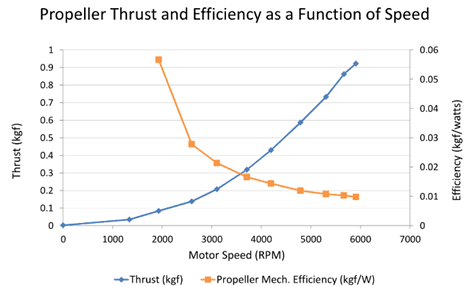
- 2Efficiency (g/W): Grams of thrust produced per electrical watt consumed. The primary determinant of flight endurance.
Systematic Motor Selection Methodology
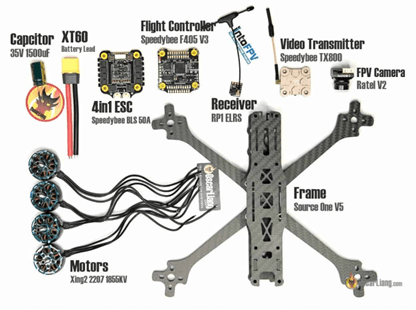
Define Operational Requirements
The Propulsion System Integration Loop
Motor selection cannot be isolated from propeller choice. Follow this iterative process to ensure optimal system performance.
Step 1: Establish Constraints
- 1Maximum propeller diameter (dictated by frame)
- 2Target All-Up Weight (AUW)
- 3Desired flight time (related to battery capacity and efficiency)
Step 2: Consult Manufacturer Thrust Data
Step 3: Calculate System Performance
- 1Total Thrust: Motor Thrust × Number of Motors
- 2Thrust-to-Weight: Total Thrust / AUW
- 3Power Draw: (Current per Motor × Number of Motors) × Voltage
- 4Estimated Flight Time: (Battery Capacity (Ah) / Total Current Draw (A)) × 60 × 0.8 (Derating Factor)
Voltage Architecture & KV Relationship
Adopt higher voltage systems (6S) for reduced current draw and improved efficiency. Use this selection rule to compare motors across different voltage systems.
Target KV ≈ (Previous KV on Lower Voltage) × (Lower Voltage / Higher Voltage). Example: A 2600KV motor on 4S (14.8V) behaves similarly to a ~1700KV motor on 6S (22.2V) with the same propeller, producing comparable RPM at lower amperage.
Advanced Engineering Considerations
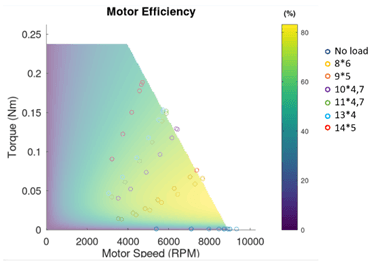
Torque vs. RPM Characteristic
- 1High-Torque Motors: Feature larger stator volume and lower KV. Provide superior propeller acceleration and responsiveness, critical for propellers with high pitch or large diameter.
- 2High-RPM Motors: Excel with small, low-pitch propellers where aerodynamic drag is minimal.
Thermal Management
- 1Stator Configuration: Open-bottom designs enhance cooling
- 2Operating Margin: Sustain operation below 80% of continuous current rating for longevity
- 3Thermal Monitoring: Use telemetry to monitor motor temperatures during initial flights
Mechanical Integration
- 1Mounting Pattern: Verify compatibility (e.g., 16×16mm M3, 25.5×25.5mm M5)
- 2Shaft Type: Pressed vs. bolt-on propeller retention
- 3Connector Type: Gold-plated bullets vs. direct solder
Build Quality & Durability Factors
- 1Bell Design: 'Unibell' (one-piece) designs are far more durable in crashes than two-piece bells. Highly recommended for Freestyle.
- 2Magnet Grade: N52 magnets offer higher power but are more sensitive to heat. N42SH or N52H are better for high-stress applications due to higher temperature tolerance.
- 3Bearing Quality: High-quality bearings (e.g., NMB, NSK) reduce vibrations reaching the flight controller (Gyros), leading to smoother flight and less 'prop wash'.
- 4Air Gap: The gap between magnets and stator. A tighter air gap (curved magnets) increases power and torque but requires higher manufacturing precision.
Professional Validation Checklist
Pre-Purchase Verification
- 1Propeller diameter and pitch are optimized for motor KV and stator size
- 2Thrust data confirms adequate thrust-to-weight ratio (>2.5:1) at 50-70% throttle
- 3Motor continuous current rating exceeds propeller-induced current draw by ≥20%
- 4Peak efficiency (g/W) occurs within the expected cruise throttle range (40-60%)
- 5Total propulsion system weight (4× motors + 4× propellers) represents <25% of target AUW
- 6Electronic Speed Controller (ESC) current rating exceeds motor maximum draw
Post-Installation Verification
- 1Motors remain at ambient temperature during idle
- 2Motors are warm (<60°C) to the touch after aggressive flight
- 3No high-pitch whining or vibration harmonics are present across throttle range
- 4Flight controller telemetry shows smooth current draw without spikes
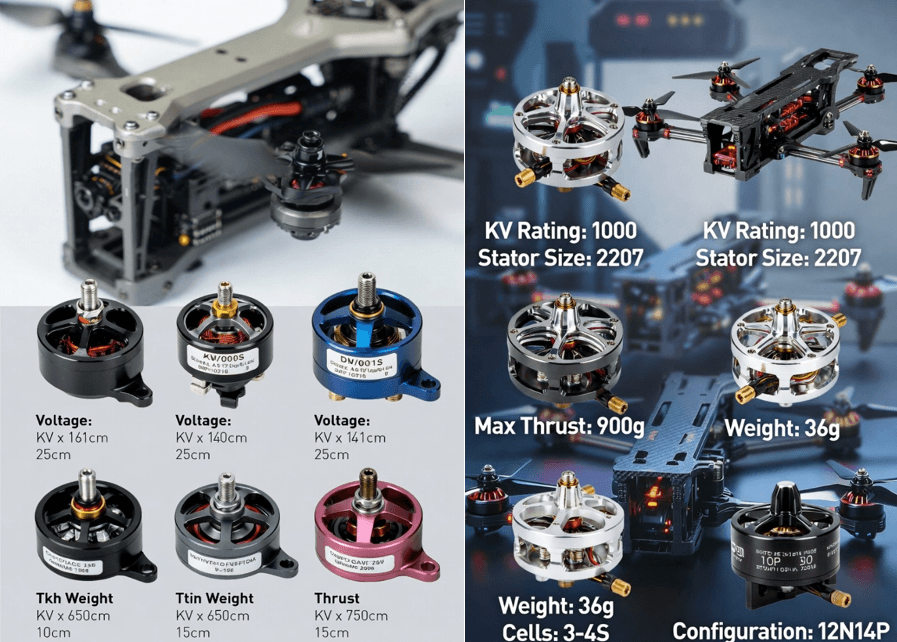
Recommended Configurations by Use Case
Final Thoughts
Selecting the right BLDC motor is engineering, not guessing. When motor, battery, ESC, propeller, and frame work together in harmony, your drone becomes efficient, stable, and powerful. A professional drone is not built with expensive parts — it is built with correctly matched parts. Take the time to understand your requirements, consult manufacturer data, and validate your selection before assembly.