
How to Choose the Right Propeller for Drone
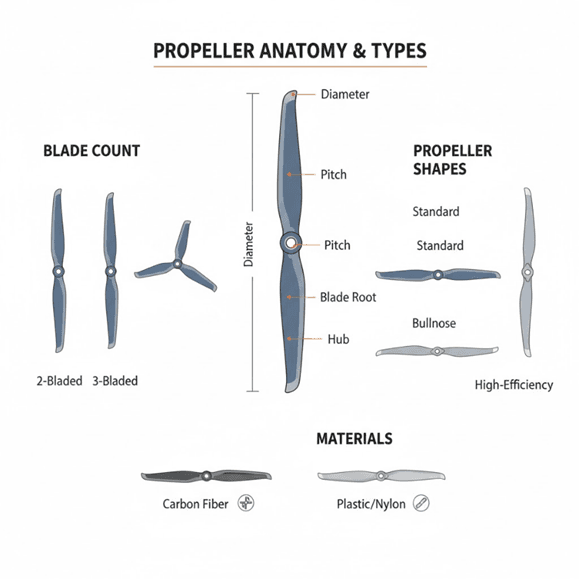
Choosing the right propeller for a drone is one of the most important steps in drone building. Many beginners focus on motors and batteries, but correct drone propeller selection directly affects flight time, thrust, stability, and motor safety. In this guide, you will learn how to choose the perfect propeller for your drone based on size, pitch, motor KV, and drone type in a simple and practical way.
Why Propeller Selection Matters in Drones

A propeller converts motor power into lift. If the propeller is not matched correctly with the motor, the drone may draw excessive current, overheat the motor, reduce battery life, and become unstable during flight. Proper propeller selection improves drone propeller efficiency, increases flight time, and ensures smooth and safe flying.
Improper propeller selection can cause motor overheating, battery drain, and flight instability. Always match your propeller to your motor specifications.
Understanding Drone Propeller Size and Pitch

Every drone propeller is labelled with two numbers, like 5045, 6040, or 7040. Understanding these numbers is fundamental to proper propeller selection.
- 1The first number = Diameter (in inches) – the total width of the prop from tip to tip
- 2The second number = Pitch (in inches) – the theoretical distance the prop would move forward in one full rotation (like a screw)
What Diameter Means
- 1Larger diameter → more air pushed → more lift
- 2Requires more motor torque
- 3Used in photography and heavy-lift drones
What Pitch Means
- 1Higher pitch → more speed
- 2Lower pitch → more efficiency
- 3High pitch increases current consumption
Match Propeller Size to Your Drone Frame and Motor
Your frame size usually dictates the maximum prop size. Always check your motor specs (stator size, KV rating) and recommended prop range from the manufacturer.
- 1Tiny Whoop / Cinewhoop: 31mm–65mm props
- 23-inch / 4-inch freestyle: 3–4 inch props
- 35-inch FPV/racing: 5 inch props (most popular!)
- 47-inch long-range: 7 inch props
Best Propeller for Different Drone Types
The size of your drone (often indicated by its motor-to-motor diagonal distance) and the KV rating of your motors are the most critical factors.
- 1Smaller Drones (e.g., Micro Drones, FPV Cinewhoops): These typically use smaller propellers (e.g., 2-3 inches) with higher KV motors (e.g., 2000KV+)
- 2Medium Drones (e.g., 5-inch FPV Drones, Mavic-style): Often use 5-6 inch propellers with medium KV motors (e.g., 1700-2400KV)
- 3Larger Drones (e.g., Heavy Lift, Professional Cinematography): Require larger propellers (7 inches and above) and lower KV motors (e.g., 300-900KV) to generate significant thrust efficiently
Blade Count: 2-Blade vs. 3-Blade vs. 4-Blade
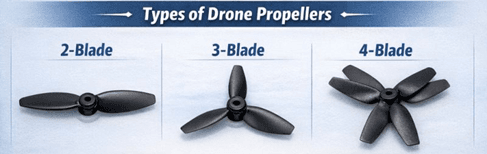
Two-blade propellers are more efficient and provide longer flight time, while three-blade propellers offer better grip, stability, and control. The choice depends on whether efficiency or control is more important for your drone application.
2-Blade Propellers
Highest efficiency, Less noise, Best for longer flight times
Less thrust in compact form
3-Blade Propellers
More thrust in same diameter, Better stability in wind
10-15% less efficient than 2-blade
4+ Blade Propellers
Maximum thrust in confined spaces, Best for aggressive maneuvering (FPV racing)
Significant efficiency loss, Higher amp draw
Drone Propeller Material Comparison
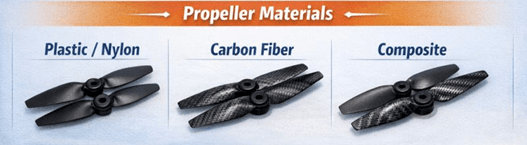
Plastic propellers are affordable but less durable. Nylon-reinforced propellers provide a good balance between strength and cost. Carbon fibre propellers are lightweight, strong, and precise, making them ideal for professional drones.
Plastic/Nylon
- 1Best for: Beginners, indoor flying, learning
- 2Pros: Inexpensive, flexible (more durable in crashes)
- 3Cons: Less efficient, can deform at high RPM
Carbon Fiber
- 1Best for: Professionals, racing, efficiency-critical applications
- 2Pros: Stiff (maximum efficiency), lightweight, precise
- 3Cons: Expensive, brittle in crashes
Composite Materials
- 1Best for: Most hobbyists
- 2Pros: Good balance of stiffness, durability, and cost
CW and CCW Propellers Explained
%26CCW(counter-clockwise).png&w=3840&q=75)
Drones use clockwise (CW) and counter-clockwise (CCW) propellers to cancel torque and maintain stability. Using the wrong direction propeller can prevent the drone from lifting properly.
Most quadcopters use a push configuration with 2 × CW (clockwise) props and 2 × CCW (counter-clockwise) props.
Always buy propellers in matched sets! Mixing them up will cause your drone to flip or not arm properly.
Battery Voltage Also Affects Prop Choice
Higher voltage = higher RPM → reduce prop size. This is a critical relationship to understand when building your drone.
Real-World Example: Professional Setup
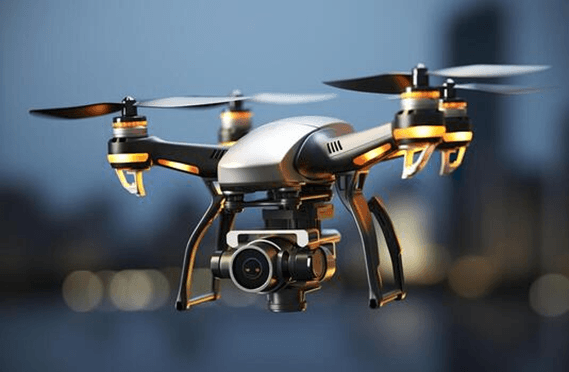
Motor: 2212 – 920KV | Battery: 3S Li-Po | Propeller: 10×4.5 nylon reinforced | Results: Smooth flight, Low noise, Long flight time
Common Mistakes to Avoid
- 1Choosing prop without motor datasheet
- 2Using high pitch for heavy drones
- 3Ignoring ESC current rating
- 4Mixing different prop sizes
- 5Using cheap unbalanced props
Quick Propeller Selection Formula
- 1Large drone + Low KV motor + Heavy load → Large diameter, low pitch prop
- 2Small drone + High KV motor + Speed → Small diameter, high pitch prop
Final Thoughts
Choosing the right propeller is engineering, not guessing. When motor, battery, ESC, and propeller work together, your drone becomes efficient, stable, and powerful. A professional drone is not built with expensive parts — it is built with correctly matched parts.